What are the main things to look for in a used piano?
If you think you might sell the piano in the future, you might want to consider the more well known brands like Yamaha, Kawai, Mason & Hamlin and Baldwin for resale purposes. These companies have been around for many years and have a history of making solid instruments.
Yamaha and Kawai pianos tend to be especially popular in the Katy area and are known for lasting a long time, for being easy to tune, and have a bright sound that many people prefer.
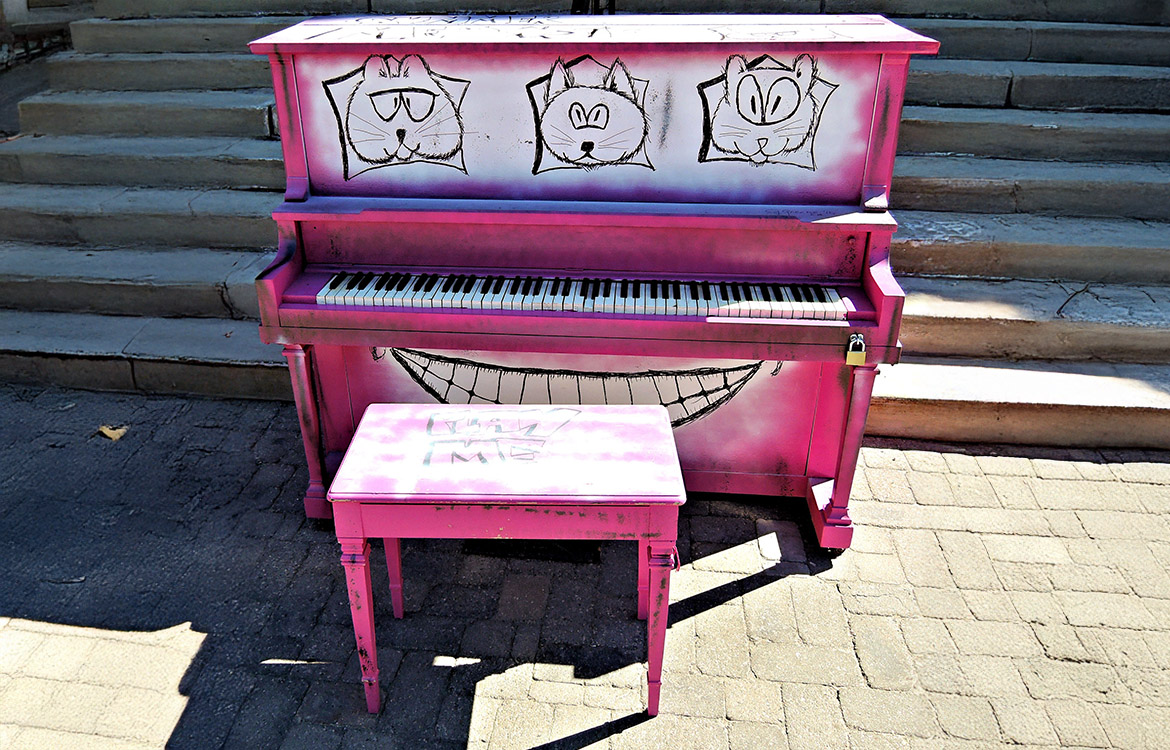
Black pianos tend to sell the easiest. I recommend avoiding pianos that come in unusual colors, like red and white if you might sell them in the future. There are also acoustic pianos with player systems built in; I would avoid these as they are unnecessary and will increase the cost of the piano.
You want a piano that is in good working condition and doesn’t require repairs. Many used pianos will probably have some small scratches and dings but those shouldn’t be problems that affect their function.
Many of the following tips are for those seeking pianos in private sales, but you can use these tips at piano stores as well.
Take an overall look first
Does the piano have major damage when you first look it over on the outside, such as a huge gouge in the body, a leg that a dog has chewed on, or water marks? Does it sit level or is it leaning or being propped up with something underneath it? Is it sturdy or does it rock if you bump it? Does it stink (animal urine, smoke)? Does it seem to have its original finish or has it been painted or altered in another way?
Does the piano display its brand name in the middle of the fallboard? It should; if it doesn’t, then that’s an issue. The brand should also not be misspelled. Usually, you won’t find pianos with these issues, but I have heard of people encountering them. You’ll be more likely to find these issues with free or very cheap pianos. I would avoid pianos with these issues.
Check out the serial number and model
You can use the serial number and model number to verify that the piano is made by the company whose name is on the front of the piano, and you can research its age and specifications. Sometimes you have to go to the manufacturer’s website to find this information. But you can confirm the size, an estimate of when the piano was built, perhaps in which country it was manufactured, etc. (although like cars, parts of pianos are now built in many different countries).
On upright pianos, you can usually find that information in the inside of the piano, when you open the upper lid. On grand pianos, you can see the information on the soundboard and the metal parts close to the keys.
Check out the keys
Are they all level as they sit there, or does it look like some keys hang slightly lower than others? Are they chipped on the edges or cracked? Do you see signs of stains from liquid spills or sticky stuff on them? Are they discolored and slightly yellowish? These could be signs of a very old piano, damaged keys, or repairs that are needed.
Make sure all of the keys work:
- When you play a key, it should have a clear sound and pitch. Play each key one at a time
- When you let go of the key, it should pop back up immediately. You should be able to play each key repetitively and quickly, with it sounding each time and popping back up quickly each time
- Try playing each key softly and loudly; it should react the same (good sound, it pops back up after you play it)
- Keys should not stick down or move back up slowly
- A key that has a weird sound from the others might be a key that needs a repair
- Beware of buzzing, vibrating sounds, clicking, or dinging/tinging. There should be no additional sounds when a key is pressed and released other than its tone
Check out the pedals
Most pianos will have three pedals. Having only two pedals can be a sign that the piano is very old. Press the pedals one at a time; they should go down and up without sound. The right pedal should sustain the sound of the keys when held down. That’s the main pedal that we use.
Pedals can be trickier to check if you know nothing about pianos. Consider taking a friend who knows how to play pianos with you when looking at them. Or consult YouTube videos such as this one: What Do the Piano Pedals Do? Note that the two pedals on the left can be slightly different in upright pianos vs. grand pianos.
Check out the inside of the piano
- Open the lid and look to see if there is rust. There shouldn’t be rust on any of the parts
- The parts should be symmetrical (if you see a line of parts, but a couple are drooping or sagging or looking irregular, this could be the sign of damage, a part that’s really worn, or a repair that’s needed)
- There shouldn’t be mold or evidence of water damage (staining)
- Beware of something that looks like a self-repair, like a rubber band holding something, tape or messy glue, etc.
Check out the music stand and the fallboard
All pianos should come with some kind of place to hold the music (music stand). That’s usually pretty obvious on a grand piano, but some uprights have a small piece that folds up and down. Make sure that piece works as it can be a piece easily damaged.
The fallboard is the wooden part on hinges that closes to cover the keys. Open and close it. The fallboard should stay up by itself.
Check out the grand piano lid
Know how to open a grand piano lid before attempting to do it. If you’re inspecting someone’s piano, you should let them do the handling of the instrument primarily, or ask permission before touching it.
If the owner has things sitting on the piano, ask them to take all of the things off, including a cover. You want to inspect the outside of the lid for damage. Be especially careful of pianos in which people put potted plants on top (please don’t do this with your piano!); plants often leak water.
Check out the bench
Most pianos are probably being sold with a matching bench. A matching bench means it’s the same wood color as the piano, has the same style of legs, etc.
Adjustable benches might be worth slightly more than a traditional wooden bench, but a bench that is solid works. Don’t let a bench determine whether or not you buy a piano. You can always buy another bench if needed at an affordable price.
Sit on the bench. Make sure it doesn’t wobble or have a loose leg. If it’s an adjustable bench, crank it so that you can make sure it goes up and down (ask the owner to do that if you’re not sure how to do that).
Ask questions about the piano
General questions you might ask include:
- How long have you had the piano? Has anyone else owned it? Did you buy it new? Where did you buy it?
- When was it last tuned? How often did you tune the piano? Who tuned it?
- Has it ever needed repairs or sustained any damage?
- Does it have any climate control systems installed in it, like a piano dehumidifier?
- Has it ever been kept in a place that wasn’t climate controlled, like a storage unit or garage? Has it been moved?
- Why are you selling the piano?
The tricky part
Most piano buyers and sellers will tell you that the trickiest part of the negotiation process is figuring out the money transaction, and how/who is going to move the piano. That is something that has to be left up to the buyer and seller to figure out.
If you are a seller or buyer, you want to make sure that professional piano movers will be moving the piano out of the home and into the new home. Do not allow others who aren’t professional piano movers to move the piano.
Even if you only paid $300 for the piano, it’s worth it to spend that much or more to hire professional movers. Too many homes have been damaged by people trying to move pianos themselves, and sadly, pianos have been tipped over or dropped.
Conclusion
While you can get bogged down on all the details and research pianos into the next year, it’s quite simple: When making a private purchase, if it seems to be a piano in good working condition in a good home environment and everything seems to be in working order on the piano, it is probably a good instrument to buy if it is within your budget. If you really want to be sure, you could hire a piano technician like Michael and Joshua Ello at Ello Piano Service to inspect the instrument before purchasing it.
Pianos can take a lot of wear and tear. They are tough instruments. They rarely —if ever—need repairs. I own two used grand pianos and have not had to make repairs. I’ve also been a classroom teacher and church musician and those pianos (which really get a lot of wear and tear!) have also never needed a repair.
Try to approach your search with excitement and curiosity instead of trepidation and suspicion. Piano shopping can be a lot of fun!