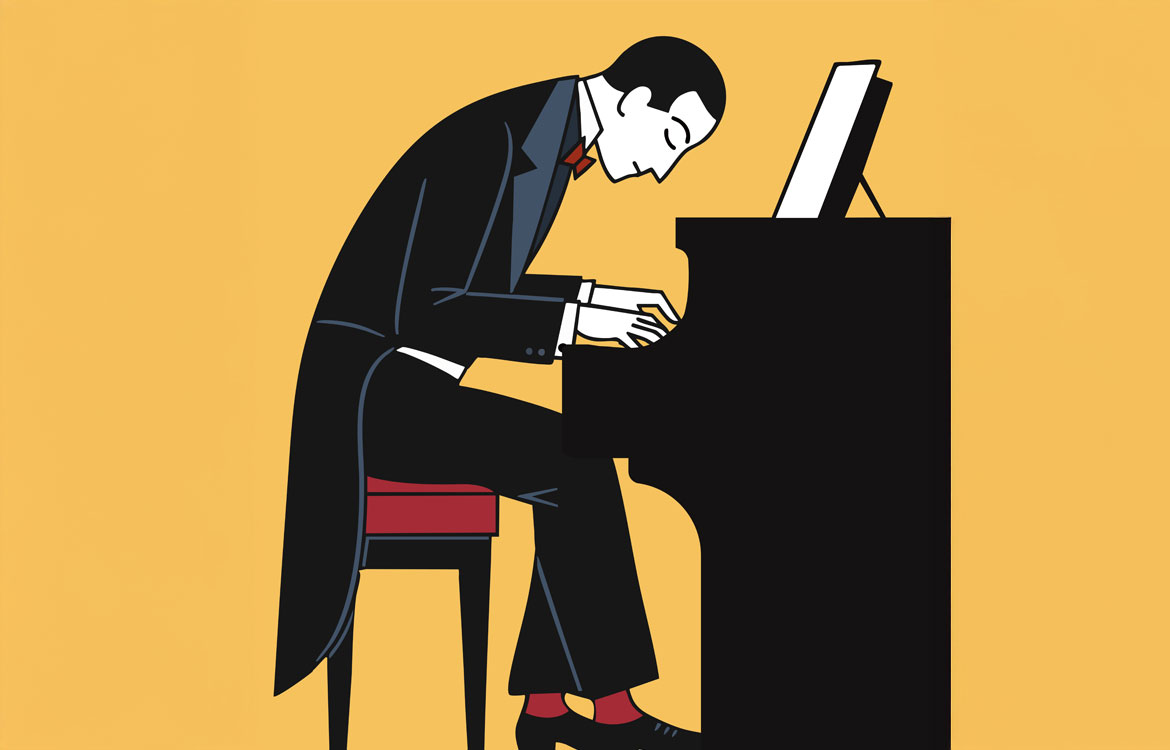
Playing a musical instrument well has often been associated with whether or not someone has talent and how much talent they are believed to have. Karen is good at the piano, her brother is not. Karen must have more musical talent than her brother… correct?
The Merriam-Webster dictionary defines talent as “a special often athletic, artistic, or creative aptitude” and, “the natural endowments of a person.” The use of the word natural implies that one is born with these abilities.
There are clear differences between the musical abilities of different people. Take some musical legends into consideration: Ella Fitzgerald, J.S. Bach, Jimi Hendrix, the winners of the international piano competitions… were they just born with it, or did they work very hard? Did they practice a lot? Did they have wonderful music instructors? Or is it a combination of factors?
Aptitude is potential, not skill
Everyone is born with different aptitudes for different abilities. Think of aptitude like an empty glass that can hold liquid. Keep in mind that we don’t all have the same glass size for different things like playing soccer, math, or music.
Talent, on the other hand, is typically thought of as skill that you’re born with. Remember the reference to Karen being good at the piano? If she’s just talented, we think that it must be almost easy for her. She probably doesn’t need to work as hard as others if she’s talented at the piano. But recent studies have shown that while natural abilities help, there are other factors involved in success.
Let’s apply the glass concept to theories of music aptitude:
The glass (representing aptitude or potential) can be filled with liquid: Listening to music from a young age, learning a musical instrument, singing in church, taking piano lessons. We get better at music as the glass begins to fill from musical experiences, but eventually, the glass will be full. Adding more musical experiences and training isn’t going to increase the size of the glass. When it’s full, it’s full.
If Sarah filled her somewhat small music aptitude glass, she would be better at music than Gerald, who had quite a large glass to begin with, but never filled it musically. This is when someone might say, “He had so much potential, but didn’t develop it.”
Consider Devin — he had a large music aptitude glass and filled it to the brim with music lessons and a musical environment. Devin is better at music than Sarah, although both had the same amount of practice hours, both tried really hard, and both had the same number of years of music lessons, etc., because his glass was bigger.
Does practice matter more than aptitude?
That depends. On several factors, and who you ask.
A child who practices the piano daily and diligently with a small aptitude glass may make more progress than a child with a large aptitude glass who practices haphazardly or only twice a week.
Roughly forty years ago, K. Anders Ericsson found that practice — more so than natural-born ability or talent — was more important in developing expertise. In other words, anyone can get good at anything if they practice a lot, and practice very deliberately.
You may have heard of the “10,000 hour” example of the accumulation of practice which leads to the mastery of something. A lot of books have been written with this in mind, and while it does have merit, the idea that practice alone can lead anyone to mastery is often lacking and doesn’t take certain considerations into account.
The role of genetics and cognitive ability in musical skill development
Sports scientists are well aware of genetics and their contribution to an athlete’s success. Regardless of training, diet, and other factors, genetics does play an important role. If you are a shorter, heavier person, you might not become the world’s best marathon runner no matter how hard you train. If you are small in stature with a thin build, you probably won’t become a great heavyweight lifter.
In the field of music, there has been hesitancy to consider the role of genetics in musical expertise and achievement. Many studies in the past were focused on how a student practices, the number of hours each week they practice, whether or not they study with elite teachers, whether or not their public school had music classes, etc., but studies focusing on genetics or cognitive abilities and whether or not they correlated with musical achievement were harder to find.
Many piano teachers (and parents) believe that anyone can learn to play the piano well, regardless of physicality, age, cognitive ability, genetics, etc., if you just try really hard. They believe that if one practices enough and with careful practicing, any student can develop great piano skills, but this is not the case for many students.
Recent research findings suggest that genetics and cognitive ability play important roles in musical mastery, which contradict Ericsson’s assertion that working hard, practicing a lot, and practicing diligently are the factors that lead to mastery or expertise.
The idea that anyone can master something with the right approach and training just doesn’t pan out in the real world. If you’ve ever worked really hard at something for years and been very diligent and mindful in your practicing attempts, only to find that your progress was minimal at best, then you know this really well. If we are objective we can probably think of quite a few things that we are not very good at and probably would never master.
The findings in recent research also indicate that there is a genetic component to whether or not kids are likely to practice their music instruments, and whether or not they will practice diligently. How many times have piano teachers heard this from parents? “I’ve tried everything but I just can’t get her to want to practice.” That could be the result of many factors, including a genetic component.
As piano teachers, we’ve seen these variables for years. Some kids try really hard to play the piano well, and they are very diligent in their learning, but they struggle to make progress. Some kids who struggle academically also struggle to learn the piano. Some kids who are successful academically struggle to learn the piano. Some kids learn quickly while some learn slowly.
As parents and teachers, we can’t always insist that Suzy just needs to try harder in order to progress in her skill development. Her music aptitude glass might already be small and full.
Conclusion
As piano teachers, we see a lot of students with different sizes of musical aptitude glasses, combined with different genetic backgrounds, cognitive abilities, musical environments and practicing tendencies.
Whether or not a child is successful musically is rarely contingent on one or two factors (unless Jimmy NEVER practices!). When a parent asks, “How is he doing in piano lessons?” that’s a difficult question to answer. Maybe, “As well as can be expected, all things considered,”is the most accurate answer.
We have to be mindful of the bell curve for music learning: A few people will be extremely successful musically, a few people will struggle immensely musically, but most people will be average musically even if they work very hard.
Learning to set high but realistic goals for piano students is important, but we need to recognize that at a certain point, there will be a plateau where we might not see much “progress” or improvement in skill development. Everyone reaches their limit for success eventually when their glass becomes full but we can always celebrate the continued effort.